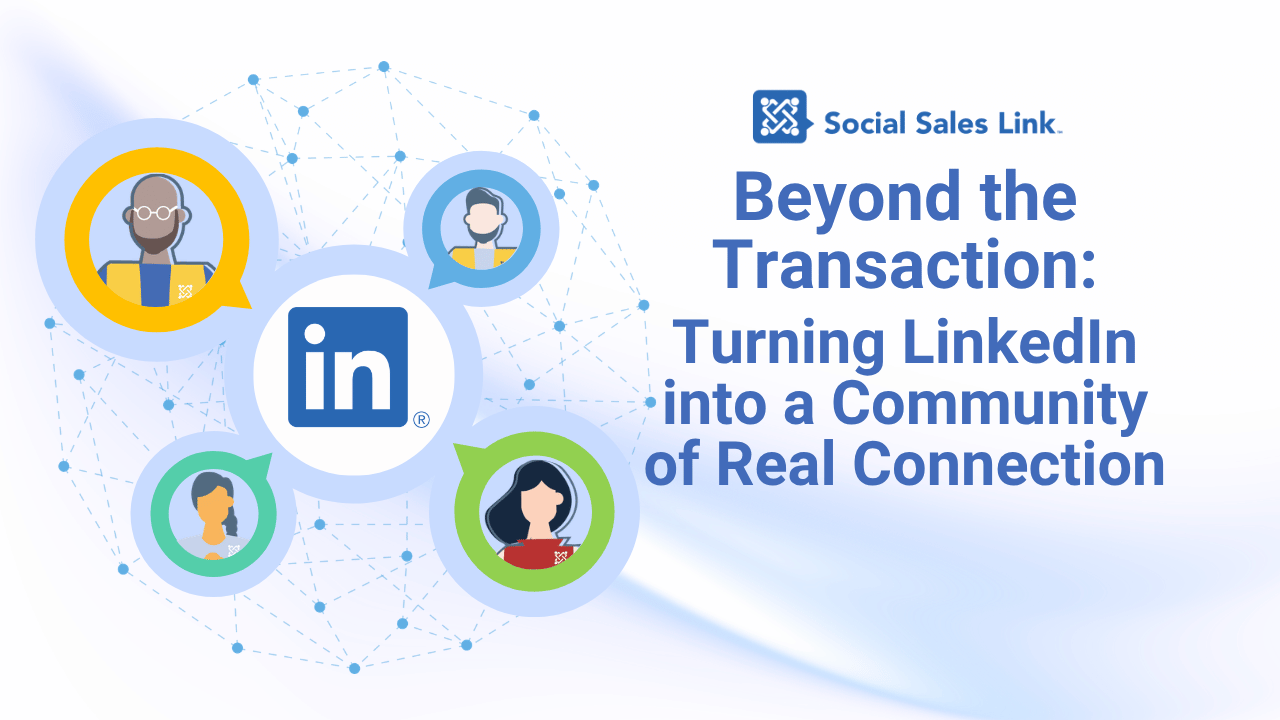
Beyond the Transaction: Turning LinkedIn into a Community of Real Connection
| April 8, 2026
We’ve all experienced it. You see a new message notification, click with a bit of curiosity, and find a three-paragraph wall of text from someone you’ve never met. It’s a pitch for a “revolutionary SaaS solution” that doesn’t apply to your industry, your role, or your current challenges.
In the modern rush to hit quotas and “scale” outreach, the original intent of professional networking has shifted. For many, LinkedIn has been hijacked—treated like a giant, digital Rolodex or a cold prospecting database where humans are reduced to row entries in a CRM.
But there is a more effective way to show up. LinkedIn is not a database. It is a living, breathing community of professionals who are looking for value, insight, and genuine rapport. They have no obligation to give anyone their time, their trust, or their attention. When we approach this platform as a community rather than a numbers game, the results shift from transactional to transformational.
Having a LinkedIn account or a Sales Navigator subscription provides the tools for networking, but it doesn’t grant an automatic audience. Neither does the pressure of a month-end deadline or a manager’s KPI.
In a physical setting, like a professional conference or a local meetup, you wouldn’t approach a group of peers and immediately start listing product features before even learning their names. That “pitch-first” approach is the digital equivalent of interrupting a private dinner party with a megaphone.
The Rule of Engagement: Every professional conversation is earned. That right is bought with consistency, presence, and genuine contribution to the community before you ever ask for a meeting.
If you find that your outreach is falling flat despite your best efforts, it might be time to pivot toward a LinkedIn for Sales: Trust-Based Strategy That Actually Works. This shift moves you away from being a “vendor” and toward being a welcomed guest in your prospect’s inbox.
AI is one of the most powerful tools in our modern toolkit. It’s brilliant for brainstorming, summarizing long reports, and organizing data. However, there is a delicate line between using AI for efficiency and letting AI replace your human connection.
Trust-based conversations cannot happen through engineered empathy.
When we use automation to scrape a profile and generate a “personalized” message that mimics human connection without the actual human behind it, the relationship starts with a lie. Professionals can sense when a comment or a message is “AI-sincere.” If a prospect realizes that a thoughtful note was actually the result of a prompt rather than a person, the bridge is burned. It’s very hard to come back from a first impression rooted in automation.
It’s easy to look at a prospect’s job title and company size and immediately calculate their potential value to your bottom line. This is a “Value-Extraction” mindset, where the goal is to take something (money, time, data) from the interaction.
To find success in a community setting, it helps to flip the perspective:
» The Traditional View: “What is this prospect worth to me?”
» The Community View: “What am I worth to this prospect?”
When you stop focusing on the potential deal and start focusing on the impact your knowledge can provide, your tone naturally shifts. You move from sounding like someone who needs a “yes” to sounding like a valuable resource who provides solutions.
The “Discovery Call” shouldn’t be the first time a prospect receives value from you. If we wait until a signed contract—or even a booked meeting—to be helpful, we’ve missed the opportunity to build the foundation of the relationship.
Instead of…
» Asking for “15 minutes” to introduce yourself.
» Pitching your service in the first connection.
» Waiting for them to ask a question.
Try…
» Sending a relevant article with a thoughtful summary of why it matters to them.
» Tagging them in a post that solves a problem they’ve been posting about.
» Sharing a “How-To” guide you wrote based on current industry trends.
Even with the best intentions, many professionals find themselves frustrated when their messages go unanswered. If you’re struggling with ghosting, you should explore Why Do Personalized LinkedIn Messages Still Get Ignored? to identify the subtle gaps in your current approach.
Are you a thought leader or a hunter? People are naturally defensive against hunters. We’ve developed “sales filters” that allow us to tune out anyone who looks like they are just hunting for their next deal.
However, we actively seek out Trusted Advisors. Showing up as an advisor means you are more interested in the industry’s problems than your own solutions. It means you’re willing to tell a prospect, “Actually, our tool isn’t the right fit for you right now,” because you care more about your credibility than a quick win. Trust and credibility are earned, not manipulated.
This is the simplest test for your LinkedIn strategy. Before you hit “send” on a message or “post” on a comment, ask yourself:
“If this person were sitting across the table from me at a coffee shop, would I say this to them in this exact way?”
If the answer is no, delete it. Digital screens can sometimes make us feel more aggressive or robotic than we would ever be in person. By keeping the “Across the Table” test in mind, you ensure that every interaction remains polite, professional, and—most importantly—human.
LinkedIn is a community of humans. It is an opportunity to have meaningful interactions and to make a genuine impact on someone’s business or career. When you stop treating people like data points and start treating them like peers, the “prospecting” part of your job becomes infinitely easier.
The Strategy in Brief:
• Earn the right to speak through consistent contribution.
• Be human; don’t let AI pretend it’s you.
• Focus on your worth to them, not their value to your quota.
• Help before you ask for anything in return.
• Advise, don’t hunt.
• Treat the person as if they were sitting across the table from you.
Don’t just fill your pipeline. Build a community. The conversations—and the deals—will follow.
How has your approach to LinkedIn changed recently? Are you finding that “human-first” is winning out over “scale”? Let’s discuss in the comments.